How to Generate Leads When Your Database Isn’t Reliable (Thanks to Guaranteed MQL++)


The reality: outdated and hard-to-use databases 

In many B2B companies, the CRM database is not reliable.
Incomplete records, outdated contacts, duplicates, invalid email addresses… data quality declines quickly.
On top of that, GDPR restrictions heavily limit the use of old files or purchased lists without explicit consent. 

As a result: 

*ICP: Ideal Customer Profile 


Why a high-quality database is essential 

A strong database is not just a list of email addresses.
It is a strategic asset that must include: 

A high-quality database enables you to deliver the right message to the right person at the right time, which is essential for providing sales teams with actionable leads. 

But what can you do when you no longer have a solid database? 

*ICP: Ideal Customer Profile 


Internal solutions to improve your database 

Before buying data or outsourcing lead generation, several internal actions can improve your data quality: 

These practices help maintain a healthy database, but they are not always enough to feed sales teams quickly. 


Hybrid solutions: buying a database + creating and distributing content 

Some companies choose to purchase external databases to accelerate prospecting.
In theory, this helps restart marketing activities quickly.
In reality: 

This is why many organizations turn to specialized lead generation services. 


Relying on an external service to generate guaranteed MQLs 

Instead of buying an unreliable list, a more effective alternative is to rely on a complete external provider.
Such a partner brings together three essential elements for generating high-quality leads: 

By combining these three pillars, organizations can generate guaranteed MQLs quickly, with consistent quality and zero risk. 

This is exactly what LeadSeed offers with its Guaranteed MQL++ service. 


The Guaranteed MQL++ service 

LeadSeed commits to both the volume and the quality of the leads delivered.
Each Guaranteed MQL++ includes: 


What sets MQL++ apart from a classic lead 


Classic Lead MQL++ LeadSeed
Collection method Simple form Interactive diagnostic
Data obtained Very limited Full context and needs
Transmission Cold Enriched handoff to Sales
Quality Variable Controlled and guaranteed
Sales acceptance rate Low 90% accepted

With MQL++, you don’t just receive a contact.
You receive a contextualized opportunity, ready for activation. 


Conclusion: generate qualified leads even without a database 

The days when you needed a massive CRM database to run campaigns are over.
With Guaranteed MQL++, you can now generate qualified leads even without an internal database, relying only on self-declared data and genuine prospect engagement. 

🎯 Discover the Guaranteed MQL++ service and experience a new generation of performance-driven, transparent B2B lead generation. 

Learn more about Guaranteed MQL++

How to Generate Highly Qualified Leads Through Interactive Content (The “Give to Get” Method)


Definition: MQL vs. MQL++ 

In B2B marketing, an MQL (Marketing Qualified Lead) is a contact who has shown some level of interest in your content or offer — downloading a white paper, attending a webinar, clicking on a campaign, etc.
But the truth is, many of these leads are cold: they’ve consumed content without real buying intent. As a result, Sales teams spend valuable time sorting, calling back, and qualifying… often with limited return. 

An MQL++, on the other hand, goes further.
It’s an enriched, qualified, and actionable lead: it includes insights into the prospect’s context, priorities, projects, and maturity level.
In short, an MQL++ is not just a name in a database — it’s a potential opportunity ready to engage. 


Comparing Traditional Content vs. MQL++ (Give to Get) 

The “Give-to-Get” Principle: Give Before You Get 

The Give-to-Get approach is simple: provide value before asking for anything in return.
Instead of forcing a download or a basic form, offer an interactive experience where the prospect immediately receives a personalized report, a guide, or a diagnostic. 

Objective: Capture Declarative Data (Zero-Party Data) 

Each interaction becomes a source of zero-party data — information voluntarily provided by the prospect, either online or through a phone conversation.
This data, far more precise and qualitative than behavioral or purchased data, helps you truly understand customer needs. 

The Psychology Behind the Model: A Win-Win Exchange 

The prospect gains clarity and tangible value (a useful diagnostic).
The company gains trustworthy, actionable insights.
It’s an ethical, personalized, and engaging approach that builds trust and increases conversion potential. 


Comparing Sales Performance 

The numbers speak for themselves: 

For Marketing, that means: less waste, better ROI, and stronger credibility with Sales.
For Sales, it means: more context, more valuable conversations, and better-quality meetings. 


The Problem: Content That No Longer Converts 

Most traditional content strategies still focus on volume: 

Example: a campaign with 500 downloads may result in only 3 truly usable leads. 

It’s the symptom of mass marketing: broad reach, but little business impact. 


The Benefits of the Give-to-Get Method for Lead Generation 

The Give-to-Get method flips the model upside down.
It’s a value-driven and personalized approach designed to build trust and deliver actionable data. 


Conclusion

Lead generation is no longer about filling up a CRM — it’s about creating useful, measurable conversations.
The Give-to-Get method turns your content into an engagement engine where every interaction delivers value to both sides. 

👉 Move from volume marketing to value-driven marketing.
Test the Give-to-Get method now with LeadSeed. 

Is Zero-Party Data The Future of Consent-Based B2B Lead Generation?


As a B2B marketer, you know that your prospects hold the keys to a goldmine of information: their needs, their budgets, their buying intentions. And under the right circumstances, they may be more than willing to let you in. 

But are you asking for access in the right way?  

Without zero-party data collection, you’re likely missing out on the most accurate, compliant, and conversion-ready insights.  

Because when you can capture the best insight data as early as possible, you gain a competitive advantage that few in your industry have. 


Ready to turn data collection into value exchange?

See how LeadSeed's Give-to-Get platform makes zero-party data collection easy and engaging. Try it now.


What Is Zero-Party Data? 

Zero-party data is information that prospects intentionally and proactively share with your brand.  

But unlike other data, zero-party data comes directly from the source itself – your potential customers who voluntarily provide their preferences, pains, budgets, and even buying intentions. 

Why the direct-give? Because there’s an evident value in the exchange, and prospects are willing to offer their best data for helpful content.  

How is Zero-Party Data Different? 

It’s important to recognize the difference between zero-party data and first or third-party data – your compliance and reputation depend on it. 

While prospects explicitly volunteer zero-party data through engagement with surveys, preference centers, or assessments, first-party data is passively collected through prospect behavior (think clicking emails or browsing your site). Third-party data is purchased from data brokers without direct prospect consent – which raises significant questions about collection methods. 

Privacy regulations are tightening, and with the disappearance of third-party cookies, zero-party data is quickly becoming the gold standard for compliant, accurate lead generation.  

The Triple Advantage of Zero-Party Data 

So, why make the shift toward a focus on prospecting zero-party data?  

B2B companies are reckoning with a data deprecation challenge as privacy laws ratchet up  – and are increasingly looking for ways to capture the best data while keeping leads satisfied. Zero-party data offers the best of both worlds. 

Zero-Party Data Offers the Accuracy Your Sales Teams Need 

Imagine a CMO “telling” you their marketing automation budget is $50,000-$100,000 via your on-page ROI calculator. That direct information is infinitely more reliable than trying to infer a budget from company size data you find online.  

Direct disclosure quickly eliminates sales-team guesswork and means your teams are working from accurate information from the start (which instantly boosts your credibility). 

Zero-Party Data Comes with Consent Baked-In 

Each piece of zero-party data comes into your system with explicit permission already included. The prospects know that they're trading information for value – and they are expecting a return on their data investment.  

By offering personalized content such as custom recommendations and reports, you build trust while keeping your B2B operations fully compliant with GDPR, CCPA, and other privacy laws. 

Zero-Party Data Allows for More Personalization Power 

Zero-party data allows B2B companies to offer hyper-targeted experiences that feel consultative rather than intrusive.  

Prospects and leads don’t want to feel “investigated” when they are engaged. But when marketing or sales teams can point to an already-provided pain point, the overall experience feels natural and tailored to specific outcomes. 


How Do B2Bs Collect Zero-Party Data? 

The key to successful zero-party data collection is making the value exchange crystal clear. That means creating give-to-get style content that feels natural and is easy to engage with – no matter the lead’s readiness. 

Interactive Content: The future is interactive – and maturity assessments or benchmarking tools are a great way to engage leads. Prospects simply input their performance metrics and receive personalized improvement roadmaps (while you get data that points to their challenges and readiness to buy). 

Strategic Surveys: Are you running lead-gen webinars? Offer post-webinar surveys that ask for any remaining questions or comments. You’d be amazed at how these simple questionnaires can give you excellent buying signals and help you improve your other interactive and personalized content. 

Value Calculators: One of the best ways to capture zero-party data is through value-related calculators. ROI calculators and TCO comparisons are great ways to capture easy data, and prospects feel they are receiving useful resources and ideas without much investment on their end. 

Integrating Zero-Party Data into Your Lead Intelligence Strategy 

Here’s where zero-party data really shines. When you start to integrate the collected zero-party data into your overall lead strategy, you’ll start to see just how quickly it works in your favor. 

Use Zero-Party Data to Enhance Lead Segmentation 

The more data you collect, the easier it becomes to build micro-segments based on self-declared interests and challenges.  

If a lead indicates they're "exploring options," you can target them further with educational content. Someone "ready to purchase within 3 months" might instead receive a comparison guide or implementation resources. 

Zero-Party Data Offers an Immediate Intelligent Lead Scoring Upgrade 

You can start to weigh zero-party data heavily in your scoring models. 

For instance, if a potential customer completes a personalized assessment and indicates an urgent timeline, you can use that data to score them much higher. The more fine-tuned the data, the cleaner your lead scoring. 

Predictive Nurturing Is Led By Zero-Party Data 

Smart B2B companies are leaning on predictive nurturing to predict the next-best actions throughout their funnels. With zero-party data, you can implement even smarter nurturing with hyper-specific insights.  

How LeadSeed Powers Zero-Party Data Across Your Sales Funnel 

LeadSeed has mastered the process of zero-party data collection through an innovative Give-to-Get platform 

Using custom-built intelligent surveys and interactive assessments, you can give your prospects even more reason to engage with your company and offer key data. In return, they receive resources and guidance that’s designed for them – personalized reports, benchmarks, and recommendations. 

LeadSeed’s no-code builder means you can rapidly deploy sophisticated data collection experiences across your channels. Now you can automate and optimize your lead scoring based on zero-party responses (and your sales team will thank you for it!) 

Experience the Future of B2B Data Collection with LeadSeed Now 

Privacy regulations are growing, and buyers are increasingly wary of data collection. That means the right data is more valuable than ever.  

Zero-party data collection will continue to be one of the most effective ways to ensure you’re targeting the right leads in the best ways.  

The future belongs to brands that ask rather than assume. Learn more about how you can start deploying smart content and capturing zero-party data today with LeadSeed. 

Book a Demo Now

How Can You Detect Weak Buying Signals Before Your Competitors Do?


Did you know that potential buyers are leaving subtle digital breadcrumbs all across your marketing channels every single day?

You likely have hundreds, if not thousands, of potential clients or customers who swing by your website or web content that end up not converting to a sale or consultation.

A revisited pricing page here, and an abandoned form there, each acts as a weak buying signal that could be turned into the first digital data piece that leads to untapped potential revenue.

The key is knowing how to find these weak buying signals and how to act on them before your competitors do.


What are Weak Buying Signals?

Weak buying signals are low-frequency indicators that suggest an early or emerging interest in your product or service.

They often appear well before explicit purchase intent, which is a key method of determining which leads are most likely to convert.

While strong signals include demo requests or direct inquiries, weaker buying signals are more micro-behavioral. Think of someone who revisits your product pages but never clicks “Contact Now” or someone who is engaging with your top-funnel content repeatedly.

They may seem weak, but once you know how to spot these signals and use them, you gain a massive advantage. Research shows that 77% of B2B buyers conduct independent research well before they ever contact a sales member.


Consider this common weak buying signal pattern:

These may seem insignificant when taken independently, but together, they show a lead who is actively evaluating your offering – and may need just a small nudge over the edge.


What are Key Weak Signal Detection Points?

Once you know how to spot these weak buying signals, you’ll start to see them everywhere.

And your lead tracking will win or lose based on how well you monitor across multiple touchpoints where this behavioral data gathers and accumulates.


One of the best places to find these signals? Across your website. Look for multiple visits to key pages (pricing, solutions, contact) and how often a lead revisits your site.


If you have a strong email strategy, you can gather more great signal data within your campaigns. Don’t just rely on open rates – look at click patterns as well.

If you find that a prospect consistently clicks through to product information (but doesn’t click a CTA), you can use that behavior to guide your next steps.


Do you have prospects who consistently start and abandon content on your site? Do they sign up for webinars but never show up? Complete forms to get more information, but don’t finish them?

Don’t count out these prospects – they may be right on the edge of making a decision, and a bit of help from your sales or marketing team could make all the difference.


Combining Signals to Assess Buying Readiness

Single signals on their own rarely tell the whole story. What B2B brands need is the ability to recognize weak signal patterns across multiple channels.

A prospect who shows three weak signals within a weak shows much higher lead quality than one strong signal over a month.


Sales prioritization requires weighting scores across different signal combinations.

Now you have a combined weak signal prospect well worth following up with!


Research reveals that companies that can spot and reply to these leads within an hour are seven times more likely to end up in conversations with decision makers. For weaker signals, this window shrinks even faster.

Consider creating a strategy for identifying and quickly scoring these leads. If someone visits a pricing page twice and downloads a case study, then your sales team should move immediately.


Turn Weak Signals into Pipeline with LeadSeed

How can you create and implement a weak buying signal strategy that results in real leads? You need a platform that upgrades your lead generation process with smart and interactive content.

LeadSeed allows B2B brands to create and deploy forms and progressive profiling tools that can capture micro-behaviors across a wide variety of interactions – even weak ones.

Using a unique “Give-to-Get” approach, LeadSeed enhances signal generation.

As prospects unlock personalized reports and smart recommendations, weak buying signals are elevated to the surface. You can then act on automatically triggered follow-up sequences based on key behavioral patterns.


Turn Weak Signals into Your Competitive Advantage

Weak signals represent tomorrow’s pipeline, today. While your B2B competitors are waiting for obvious intent, those who can master early signal detection can better shape their entire buying journey.


With LeadSeed, you can use smart and personalized content to drive engagement across your channels and identify weak signals faster. Boost your win rates and shorten your sales cycles with smart tools that recognize and nurture even the weakest – but highly valuable – signal.


Try LeadSeed Now

How to Scale Personalization and Automate Lead Qualification Without Losing the Human Touch


Nearly every B2B business faces the same challenge: how do you qualify hundreds or thousands of leads without losing the human touch that creates long-time raving fans?


The traditional approach – generic forms followed by manual scoring - isn’t working with the modern customer base. According to Gleanster Research, only 25% of marketing-generated leads are of high enough quality to advance directly to a sales conversation.


The problem? An inability to balance capturing quality data with non-obstrusive tactics.

The solution isn’t choosing between automation and personalization. In fact, you might be able to strike the perfect balance using intelligent content that delivers both at scale.


Want to see how lead qualification can stay human while boosting success rates? See how LeadSeed’s Give-to-Get personalized content technology is helping B2B brands land better leads with intelligence. Try it now!


Your Traditional Lead Qualification Methods Might Be Driving Your Best Customers Away

Data is gold in sales. It doesn’t matter if you are selling software or season passes to sporting events – if you can figure out the best customers to target and sell to, you can see a greater return on your marketing investment faster.


The problem? Most companies still rely on outdated lead qualification methods that end up creating more problems than they solve.

Manual qualification methods are typically slow and subjective.


Two sales reps may score the same lead very differently based on their gut feelings. Static forms that ask site visitors the same general questions only capture surface-level information, and customers get frustrated when sales teams ask the same questions again on a call.

Each repetition of a step in the lead qualification process not only frustrates your customer but leaves your sales teams feeling ill-equipped to make sales. The spiral of wasted marketing budget and decreased productivity continues.


How to Use Personalized Automation to Drive Lead Qualification (and Give Your Customers Real Value)

The top B2B companies have quickly learned that they need to switch their lead qualification tactics or get left behind. What have they switched to? Personalized smart content that turns static forms into automated, relevant experiences.


Imagine offering a potential lead a dynamic questionnaire or form that feels less like a general interrogation and more like a consultation.

One where every piece of contextual data the lead gives is used to offer usable insights that can be used immediately to enhance their lives?


Progressive profiling can transform how you gather your lead data for qualification. Instead of demanding 15 fields upfront, you can start with just a name and email. As the lead engages with more content, the smart content system automatically requests additional relevant details. For instance, a prospect downloading a pricing guide may see different questions than someone signing up for an upcoming webinar.


Interactive quizzes build on this concept by offering immediate value in exchange for information. A manufacturing company may create an “Industry 4.0 Readiness Assessment” that delivers personalized recommendations while simultaneously qualifying leads based on questionnaire responses.


At its core, this shift to a “give-to-get” approach positions data collection as a value exchange rather than a tax on accessing content.


The Power of Automation in Personalized Lead Qualification Content

Modern lead generation and qualification platforms use branching logic and AI to build real-time paths for each prospect.


Indicate that you’re in the healthcare field? The questions explore HIPAA compliance needs. Move the indicator to “I have 500+ employees”? The system moves to enterprise-specific challenges.

But it’s not just automation for automation’s sake. These systems also create a historical “memory” of a potential lead – so when they return to your website a month or two later, the system is already pre-loaded with the data they’ve already offered.


This personalized automation makes the sales handover process far more human. Sales reps, equipped with a complete prospect profile, can now lead the conversation from a place of personalized care and trust. Specific problems are addressed faster, and prospects feel known in a natural way – a key psychological step that leads to higher rates of success.


Sales teams report faster initial conversations when they are armed with progressive profiling data. Close rates improve because the reps are focused on the prospect's needs, and they aren’t wasting time on non-qualified leads.


Start Harnessing Human-Centric Personalization at Scale with LeadSeed

B2B companies can industrialize qualification without sacrificing the human element. It just requires the right platform built on modern, adaptive experiences that feel human – even when engaging thousands of prospects simultaneously.


LeadSeed leads the personalized lead generation and qualification market with a platform built on the “give-to-get” philosophy. Under the smart automations and intelligent logic engine is the idea that prospects who feel cared for respond more favorably.

Personalized reports, ROI calculations, and maturity assessments – LeadSeed allows you to create them all white-label, ensuring you collect the best lead qualification data while building a reputation for being a customer-first organization.


Balancing automation and personalization in lead qualification isn’t about choosing technology over humanity. The best B2B companies recognize that intelligent systems enable human sales teams to deliver exceptional customer service with significantly reduced resources.


So, will you take advantage of the future of qualified conversations?

Try LeadSeed for yourself today, and see why the move to human-focused, personalized content is changing how B2B companies grow and scale.

How To Upgrade Your B2B Lead Generation with Interactive Content


Stop relying on static content to drive conversions. The future is personal and interactive.


At A Glance:


B2B buyer attention is fragmented, with companies trying to lure in customers while staying novel from their competitors. The problem? Too many companies are relying on outdated, traditional lead generation methods that don’t deliver true value.

PDF resources are downloaded, but never acted upon. That “Ultimate Guide To Industry Success” your marketing team built looks great, but you don’t have a way of knowing if the free insights are hitting the mark.

When sales cycles shorten and competition rises, you need to deliver real value really fast.

And with interactive content – think clickable calculators, quote generators, insight questionnaires – you can drive engagement with your highest-intent leads and gain data on prospects like never before.


Here’s Why Interactive Content Outperforms Static Assets in 2025

The latest research makes it obvious that static content is no longer enough. 81% of marketers say interactive content is grabbing more attention (and valuable leads) than traditional whitepapers or PDFs.

Interactive content is seeing 52% higher engagement than static, passive assets. In short, your buyers prefer interacting with content that feels educational rather than obviously sales-focused.

But why?


Interactive Content Delivers Value Through Personalization

Unlike generic content, personalized and interactive assets create a give-to-get engagement cycle with prospects.

For instance, a TCO calculator can give potential buyers a result in the browser that they can use right away – all in exchange for some contact information.


Active Engagement vs. Passive Downloads

Think about the last time you downloaded a “free guide” or “resource kit” and never opened it?

Interactive content keeps the lead actively engaged within the same window and filters out casual buyers who are unlikely to convert. When you can keep serious buyers engaged, you instantly increase your chances of hooking them into a conversion.


Mobile-Optimized Experiences Convert

Traditional PDFs and similar content just don’t work well on mobile devices.

By switching to interactive content that adapts across devices, you can deliver more value in real-time, no matter where they may be when they land on your page.


Interactive Content Enhances Lead Intelligence Efforts

Your downloadable PDFs may look great – but are they capturing any actionable buyer intent information?

Do you know whether Prospect A, who downloaded your guide yesterday, is worth calling over Prospect B, who requested it today?


Interactive content helps bridge the gap by capturing behavioral data based on how prospects engage with the calculators or quote generators.

For instance, a prospect who explores enterprise features through your TCO calculator may reveal their budget capacity and readiness to get started.

Those looking to compare metrics against industry benchmarks are giving you golden nuggets of insight on buyer pain points and their improvement goals.


These insights allow you to build better buyer personas and speed up your sales velocity. Now, marketing and sales teams can align over the same interaction data and collaborate throughout the sales funnel.

The result is that your sales team can land warm, educated leads with data-backed needs. Suddenly, you gain data across calculations, comparisons, and configurations, which becomes intelligence that shortens cycles and increases close rates.


How LeadSeed Turns Interactive Content Into Your Lead Generation Engine

LeadSeed leads the market in interactive lead generation content that is proven to work.

B2B buyers using LeadSeed’s platform can quickly create and deploy content tailored to their target audience, delivering real value. Here’s how the platform can help you immediately upgrade your content strategy:

No-Code Builder Means You Can Deploy Content Faster

LeadSeed’s platform features 20+ components for creating sophisticated questionnaires and forms without any technical expertise required.

You can build TCO calculators factoring in dozens of unique variables, or spin up dynamic quote generators – all in a few clicks. Powerful logic systems mean your prospects only see relevant questions based on their previous responses.


Automated Personalization At Scale

Every LeadSeed interaction generates two unique outputs: a personalized piece of content for prospective customers, and strategic intelligence your team can use to score leads and develop relationships.

Plus, all content is branded and built to scale – so there’s no reason not to start creating interactive content!


Omni-Channel Distribution Keeps Your Content Working Across All Channels

Most B2B companies interact with prospects across a variety of channels. Whether your prospects interact with email, social media, or your website, you can keep all of your LeadSeed interactive content integrated through a single dashboard.


Gain more insight into what kinds of content are working best for your company – and where – and adapt to reach more clients faster.


Start Creating Interactive Content That Customers Love with LeadSeed

Static content isn’t reaching your most valuable customers anymore. It’s time to make the switch to interactive content to help your sales teams connect with high-value customers faster.

Book a demo today and see how easy it is to start building interactive, personalized content built on the Give-to-Get philosophy. It’s time to upgrade your lead generation efforts – and LeadSeed is leading the way.

Try LeadSeed Now

The Best Methods for Creating a Smooth, Efficient Lead Gen Customer Journey


Every B2B company wants to master their customer journey. From that first interaction a potential client or buyer has with your brand to that glowing review you share on your site, happy customers mean repeat (and growing) business.

So why do so many B2B brands leave qualified leads out to dry? The reality is that even the best product or service means nothing if a lead isn’t well-nurtured.

And with the average B2B lead gen journey including anywhere from 6 to 10 people per buying group, you may not even realize that you are creating friction and frustration along the way. What you need is a smooth, efficient lead-gen customer journey that is dynamic and personalized. One that helps every lead move through each stage of their unique journey and feel like they are the star of the show.

Let’s look at how to make it happen.


Stop leaving your best quality leads without a clear plan. LeadSeed’s Give-to-Get personalized content tools help you put lead gen on autopilot. Schedule a demo now.


What Is The Modern B2B Customer Journey?

You may have a hobbled-together lead-gen method, but is it delivering real, converted, paying customers to your bottom line?


Research shows that the growing complexity and expectations of buyers mean your lead gen journey needs to be adaptable and customized. While every lead is unique, there are five typical stages to the B2B customer journey:

    1. Awareness: A prospect recognizes that they have a specific problem or opportunity. They can’t meet it on their own, so they begin to research (usually online) to find potential solutions.
    2. Consideration: Buyers begin to evaluate different solutions, comparing pricing, features, credibility, and more. They’re engaging with content and making micro-decisions on whether or not a particular option fits..
    3. Evaluation: The real decision makers are involved, and they begin to narrow their options. This can include scheduling demos, requesting trials, or hopping on a sales call.
    4. Decision: The buying group makes the final decision on a purchase based on their internal criteria and how well a particular solution may deliver.
    5. Success: The buyer is now post-purchase and is starting the engagement process, determining whether or not they’ll become a brand advocate or a detractor.


Once you know how each step in the process flows, you’ll start to see opportunities to connect with buyers faster and more effectively. The key is knowing how to catch their attention with personalized content that nurtures and converts faster.


Tips for Optimizing Your Lead Nurturing and Conversion at Each Step of the Journey

Knowing the pathways is just the start. You need to stand out by taking steps to customize each to be more personalized and smart – offering insights and value that B2B customers have come to expect.


Awareness Stage Optimization

Don’t let potential leads “move on” from you without hooking them. This means creating educational (value-leading) content that immediately addresses pain points.

Use SEO (and AI-focused optimizations) to help more leads see your content online and move them through the research stage without extra friction. Use testimonials, qualitative social proof, and other high-value content on all your channels.


Consideration Stage Enhancement

This is when smart, personalized content can completely overhaul your journey. Using a tool like LeadSeed, you can build comprehensive comparison guides that highlight you as the best solution.

Offer give-to-get surveys that send over custom insights in exchange for lead scoring data. Gate premium content (when necessary) to capture information while helping show that your expertise is legitimate.


Evaluation Stage Acceleration

Find customizable yet simple ways to reduce any friction from the evaluation process. This can include implementing automated demo scheduling systems or creating personalized proposals based on any data you’ve gathered from buyers through personalized, give-to-get content.


Decision Stage Support

Stay transparent with your pricing structures and give realistic (and customized!) implementation timelines.

This can help your leads plan their potential rollout and reduce their perceived risk of working with you. Adapt these into personalized content you can deliver early on to move them to a decision point faster.


How LeadSeed Creates Optimal Customer Journeys

LeadSeed takes the lead-gen customer journey and embeds value exchange at each touchpoint. Instead of expecting leads to move through the process on their own, LeadSeed equips you with tools to engage and guide buyers toward the decision point faster.


Personalized, Intelligent Entry Points

LeadSeed allows you to create smart surveys that act as natural conversation starters. These simple surveys offer immediate value by giving leads personalized insights in exchange for rich lead qualification data. It kicks off a typically cold relationship with a warm feel.


Dynamic Journey Mapping

Based on the survey responses you gain through your smart content, LeadSeed automatically adjusts the customer journey to better fit where they are at the moment.


Efficient, Effective Lead Handoffs

LeadSeed’s true power is helping you score leads faster and use integration capabilities to transition leads between marketing and sales. Once prospects reach high-intent stages, sales teams will immediately receive comprehensive intelligence that can drive personalized conversations.


Continuous Engagement

LeadSeed is built on a Give-to-Get model that keeps engagement valuable by constantly delivering real value to leads. Your leads will give you data in exchange for customized reports and recommendations that address their specific situations.


Multi-Channel Orchestration

Do your leads prefer email contact? Social interactions? Website engagement? No matter how a lead engages, LeadSeed meets them there with personalized experiences. Plus, co-branding capabilities help you optimize your partner channels, multiplying reach quickly.


Want To See A Better Lead Gen Journey In Action? Try LeadSeed Today!

Studies show that 80% of customers value the experience they have with a company over the actual service they provide – so you need to invest in that experience if you want to build raving fans.

Optimizing your B2B customer journey is one of the best ways to do it – and create ongoing value that current customers will refer to their friends in the market.

Making each interaction more valuable and connected to the next stage in the journey will show leads that you care for more than just a profit. That will immediately boost your chances of being the solution they choose and trust for the long run.


Want to see it in action for yourself? Schedule a demo today and sign up to get started with smart, personalized content that will immediately boost your lead generation methods. Join the companies that are making their customer journey personal with LeadSeed.

Why Has Personalization Become the #1 Lever in Lead Generation?


We work with brands and businesses every day who tell us the same thing: they’re sending out what they think are great emails and newsletters to their lists, but not seeing real results that justify the time spent on them.

Sure, open rates are high, but responses and click-through rates are frustratingly low. Even when website traffic is growing, not seeing conversions = spinning your tires in the mud.


What are so many brands missing? The fact that customers and clients are getting hit with advertising techniques every day, and most are selling the same message:

Buy from us because we’re great!”


What’s needed is a way to break through the typical marketing method and start generating quality leads faster. The answer is personalization. By taking your typical lead generation methods and offering real, customized value to leads, you’ll be amazed at how fast they start signing up for calls and demos.


Want to learn more about how to supercharge your lead generation with personalization? Check out LeadSeed’s “Give-to-Get” content in action now.


How Personalization Is Meeting (and Exceeding) Customer Expectations

The days of spray-and-pray marketing are draining ad accounts everywhere. B2B buyers in particular aren’t interested in a copy-and-paste interaction with businesses.

They want solutions that give them actionable data or insights they can start with – and then come back and pay for the real deal.


Personalization in lead generation makes this possible. The stats prove it: 72% of consumers say they only engage with personalized content, and B2B brands that take steps to personalize their lead gen experience can see up to 80% increases in conversion rates.


Why so much success? Because it’s novel. Business owners and consumers alike are drowning in content and marketing that looks like everything else. Add in AI-generated content, and it’s starting to feel impossible to find something that feels relatable and useful.

Prospects want to engage with brands and businesses that are genuine in their messaging and outreach, and creating personalized lead generation content is a great place to start.


How Dynamic Content Is Upgrading Lead Generation

Dynamic content is the next evolution of personalized messaging. Unlike static content (which stays the same for everyone), dynamic content adapts to the user based on their engagement behavior, industry, customer size, and more.

Behavioral Triggers

If a prospect comes to your site to download a pricing guide, your dynamic content engages with them through a survey or questionnaire to present customized answers based on their answers and similar competitors.


Smart Forms & Surveys

Traditional forms ask the same (often unrelated) questions over and over. That’s a sure-fire way to see leads stop and leave mid-survey. Dynamic, smart content can remember past interactions and change questions based on answers – improving completion rates.


Targeted Messaging

What if your content could adapt based on who is visiting? Dynamic content can shift the messaging from price calculators for CFOs to campaign metric insights for marketing directors.


The impact shows that personalized content works. Those using persoanlized emails see 29% higher open rates and 41% higher click-through rates than generic content.


How LeadSeed Enables Hyper-Personalized Marketing at Scale

LeadSeed uses a proprietary Give-to-Get approach to dynamic, personalized content that makes lead generation a truly two-way street.

Instead of guessing what prospects want in their engagement with your brand, LeadSeed equips you to ask and deliver personalized value immediately through specific, relevant channels.


Using intelligent surveys and assessments, LeadSeed allows you to quickly capture the most important, contextual data that enables more accurate lead scoring and outreach. This data collection can be used to provide hyper-personalized experiences:


When you can combine personalization with real value, you’ll see your conversion rates climb and your client satisfaction go up along with it. What better way to kick off a new client relationship than with a foundation based on real value?


See How Personalized Content Works For Your Brand Today

83% of B2B marketers who are using personalized content for lead generation report improved efforts – almost immediately. And with competition going up, you can’t afford to lose ground to other businesses taking advantage of the best methods.

Sign up for LeadSeed today and explore how you can start using personalized marketing content to your advantage.

How to Use Lead Scoring to Connect With Qualified Leads


How to Use Lead Scoring to Connect With Qualified Leads (And Get More Out of Your B2B Marketing)

Do you ever feel as though your sales team is losing hours chasing down unqualified leads while “hot prospects” always seem to fall through the cracks?

If you don’t have a systematic approach to prioritizing leads, you’re likely losing both time and revenue to competitors who are identifying and acting on qualified leads faster.


But we act on all the leads we get – we just don’t know which are actually “valuable”. Does anyone?

They do – in fact, companies that implement a quality lead scoring system see up to 30% increases in conversion rates and a 20% boost in sales productivity. Why? Because when teams feel that they are set up to win with the right leads, they’re more likely to work harder and faster.

Let’s take a closer look at lead scoring and how setting up the right lead scoring strategy can overhaul how you approach your B2B marketing funnel.


Want to see how you can automatically score and qualify leads while delivering personalized value to your prospects? Schedule a demo with LeadSeed to see our Give-to-Get approach in action!


What Is Lead Scoring? Why Does It Matter for B2B Marketing?

Lead scoring is a methodology that assigns numerical values to prospects based on their likelihood to convert.

In other words, you create a “filter” by which you can weed out prospects who may not be ready or willing to move ahead, and focus all your time on those who are just a click away from a purchase.


How Do You Score Leads?

To score a lead, you need to combine both explicit and implicit data – information that gives you a better idea of the prospect from a holistic perspective.

Explicit data for B2B prospects can include…


While implicit data for a B2B prospect gets more technical:


When you collect this information and put it into a scoring system, you can better identify those prospects that fit your ideal client profile.

These top scorers should then become your sales team’s top priority, as they’re most likely to make a purchasing decision based on your service fitting their needs at this time.


How To Implement an Effective Lead Scoring Strategy

Knowing what data to collect is only the first step in a lead scoring strategy. You’ll then need a process by which you filter, assign, and act on each one as you score them.


1. Define Your Ideal Customer Profile (ICP)

As mentioned above, your leads will score based on how closely they align with your ideal customer profile. If you don’t currently have an ICP, you’ll want to craft one (or several) to best define the client that fits your offering.

ICPs typically take the form of a person – such as “CFO John” – and will be described by those explicit and implicit data points that you’re collecting.

In essence, your ICP and data collection strategy will go hand in hand. If you feel that your top-scoring leads aren’t converting, you may want to reconsider your ICP.


2. Assign Lead Point Values

Not all actions that a prospect takes will carry equal weight. That’s why you’ll want to give point values to each “action” to build a more accurate view of where a lead lands in your scoring system.

For instance, you can give high-intent behaviors higher scores:


You’ll also want to include negative scores for leads that take actions showing disinterest or don’t fit your overall ICP.

These can include unsubscribing from marketing emails (-20 points) or not engaging with your brand over a long period of time (-10 points per 30 days of inactivity).


3. Set Thresholds for Scoring Your Leads

Once you start giving points, set the minimum score that qualifies a lead as worthy of sales outreach. You’ll want to track data over time and experiment with this number, as it could change based on different metrics and conditions.

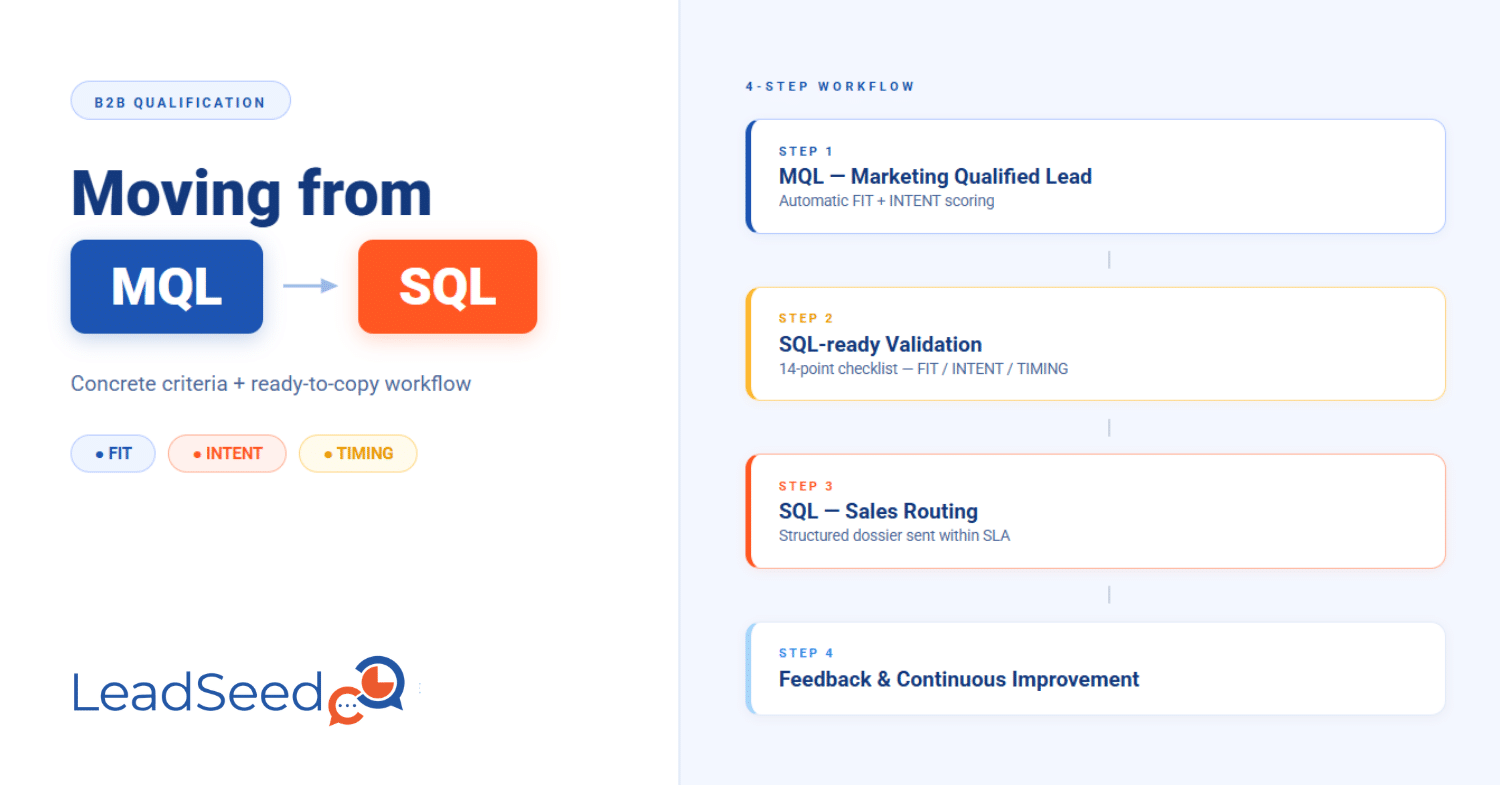
Typically, leads scoring 70+ on a 100-point scale will be considered “sales qualified” or SQL. Those scoring just under may need a bit more nurturing through personalized content or softer touchpoints.


4. Integrate Your Lead Scoring System with Your Tech Stack

As you can imagine, manual lead scoring can be a slog – and actually eat up the time that teams should spend on qualified leads! That’s why you’ll want to find a tech solution that combines your scoring system with a CRM and marketing automation solution to speed up the process.


5. Analyze and Revise Your B2B Lead Scoring as Needed

Markets change, customers change – so too should your lead scoring system.

As you begin to notice shifts in buyer behaviors, don’t be afraid to revisit your lead scoring system and make adjustments. The more you fine-tune your lead scoring strategy, the more likely you are to make use of it.


How LeadSeed Enhances Lead Qualification and Conversion for B2B Marketers

Once you get an idea of how best to score your leads and prospects, you’ll want to make sure that you are offering the right content and engagement pieces to collect relevant and accurate data. Don’t just rely on an email from a prospect as a +30 prospect value.

When you can get granular and pull insights from your prospects consistently, you’ll start to get a much clearer picture of who that 70-100 point lead really is.


LeadSeed’s innovative “Give-to-Get” approach takes traditional lead scoring and upgrades it with value exchange. By creating personalized surveys and assessments for your prospects, you can offer valuable content tailored to them in exchange for valuable lead scoring data points.

With automation built in, you can start scoring leads based on multiple criteria:


LeadSeed integrates with existing CRM systems and can help you automatically route high-scoring leads to your sales teams with detailed context on each. This equips your teams with all the data they need to kick off conversations with a personal touch.


Want to learn more?

See a powerful lead scoring system in action and start building your own lead system with LeadSeed today. The power of personalized content-driven lead generation is in your hands – get started with LeadSeed today.


Try LeadSeed Now