How to Boost B2B Engagement Rates with Ultra-Personalized Content


In a B2B landscape where inboxes are overflowing and decision-makers’ attention spans shrink year after year, generating engagement has become a strategic challenge.
Opening an email, clicking a link, replying to a message, completing a diagnostic… every interaction has become rare and highly valuable. 

Before trying to improve campaign performance, it is essential to understand what engagement rate really means and why it is collapsing in most organizations. 


Engagement rate in B2B: a critical yet underestimated indicator 

Engagement rate measures the ability of a piece of content or a campaign to trigger an action.
In B2B, engagement is not a like or a comment. It is a signal of how relevant your message is to a decision-maker. 

It is measured through: 

When engagement is high, your content directly resonates with the prospect’s priorities.
When it drops, the message is simply perceived as irrelevant. 


Why engagement is decreasing in B2B 

Most B2B campaigns fail because they rely on a generic, non-contextualized approach. Decision-makers receive standardised emails based on incomplete or outdated information. 

Three major issues explain this decline: 

  1. Poorly defined ICPs and outdated personas, leading to broad, ineffective targeting. 
  1. Messages that lack context, sent at the wrong stage of the buying journey. 
  1. Superficial personalization, limited to first name or company name. 

The result: open rates stagnate, click-through rates decline, and prospects ignore the content entirely. 


The key to engagement: content aligned with the prospect’s real context 

Personalization is no longer about inserting a first name in a subject line.
A B2B decision-maker engages when the content helps them move forward on a real business challenge. 

This level of engagement relies on three pillars: 

  1. Deep knowledge of the prospect

Industry, company size, role, responsibilities — but also projects, constraints and maturity level. 

  1. Declared data

Declared data is information the prospect shares voluntarily: challenges, priorities, needs, pain points.
It is the foundation of truly relevant communication. 

  1. Interactive content

Diagnostics, quizzes, assessments…
These formats create a two-way interaction and deliver instant value (results, scoring, recommendations). 

Interactive content is not consumed.
It is experienced. 


How personalization mechanically boosts engagement 

Ultra-personalized content drives engagement because it speaks directly to a specific need or situation.
Decision-makers do not have time for generic narratives. 

When messages reflect: 

engagement increases significantly.
Declared data turns a simple contact into a meaningful conversation.
It enables precise, timely and relevant interactions throughout the journey. 


Why interactive personalized content outperforms traditional campaigns 

Organizations leveraging interactive and contextualized content typically observe: 

Beyond improving engagement, personalization strengthens lead quality.
Prospects who engage with personalized content become more reliable MQLs and convert faster into SQLs. 


Conclusion  

Engagement is no longer about sending more emails, but about delivering relevant and meaningful messages.
In a saturated B2B environment, only content that is useful, contextualized and personalized truly captures decision-makers’ attention. 

Today’s most effective campaigns rely on a clear combination of:
- precise targeting,
- interactive content,
- declared data,
- advanced segmentation,
- and a prospect experience built around real business challenges. 

This approach not only increases engagement rates, but also improves lead quality and sales conversion. 

👉 Want to boost engagement through ultra-personalized content?
Discover how LeadSeed helps you collect declared data and generate highly qualified MQLs through interactive experiences.

How to Improve Sales Qualification to Shorten the Sales Cycle 


In a B2B environment where buying cycles are becoming longer and more complex, sales qualification has become one of the most powerful levers to accelerate conversions.
Yet many organizations still treat qualification as a simple administrative step, even though it directly impacts sales efficiency and the overall velocity of the pipeline. 

Before exploring how to improve it, it is essential to understand what sales qualification really is and why insufficient qualification creates significant friction. 


What Is Sales Qualification? 

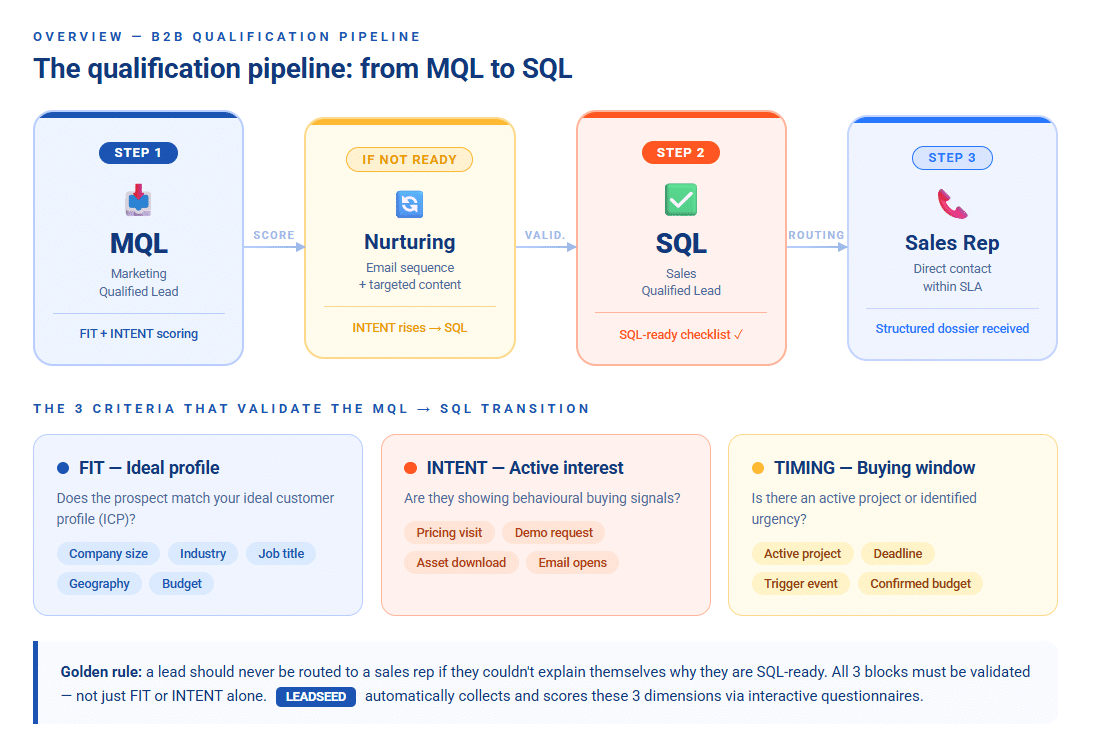
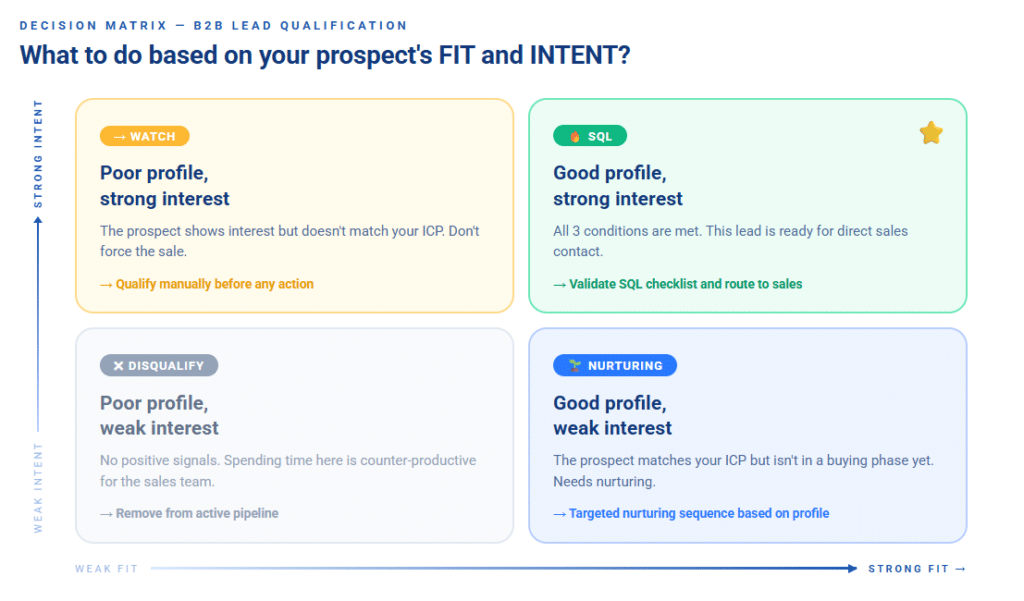
Sales qualification determines whether a prospect has the right profile, the right context and the right conditions to become a true commercial opportunity. 

It relies on three simple but essential questions: 

In B2B, qualification is the bridge between: 

The more robust the qualification, the more time Sales teams save throughout the entire cycle. 


Why Poor Qualification Lengthens the Sales Cycle 

When qualification is weak, inefficiencies accumulate quickly. 

Sales teams spend time on irrelevant prospects; discovery calls become excessively long due to a lack of information and recommendations are less accurate because they rely on assumptions rather than context.
As a result, sales cycles stretch out, opportunities stagnate in the pipeline and the likelihood of losing deals increases. 

Poor qualification also creates misalignment between Marketing and Sales.
Marketing sends MQLs that do not fit the expectations on the ground, Sales reject SQLs, and both teams lose trust in the data being exchanged. 

Finally, without clear context, it becomes difficult to prioritize truly mature prospects.
The organization ends up treating all leads the same way, regardless of their real potential. 


The Essential Information for Effective Qualification 

High-quality qualification relies on a detailed understanding of the prospect.
The following elements are critical: 

This information forms a strong foundation for reducing friction in the sales cycle.
With this context, Sales teams can start conversations that are immediately relevant and solution-oriented. 

The most reliable way to gather this information is through declared data—information provided directly by the prospect via diagnostics, questionnaires, audits or interactive assessments. 


Best Practices to Improve Sales Qualification 

To shorten the sales cycle, qualification must become a structured and continuous process. 

The first step is to clearly define both the ICP (Ideal Customer Profile) and buyer personas, ensuring that Sales teams are not overwhelmed with leads that do not match your target. 

The use of a structured qualification framework also adds consistency across teams.
Common models include: 

Collecting declared data before Sales intervention is another decisive factor.
Diagnostics, questionnaires and interactive audits provide a rich level of insight before the first conversation even begins. 

This approach transforms the Sales process:
Instead of spending time uncovering basic context, Sales reps start conversations with a clear understanding of the situation, drastically reducing back-and-forth and exploratory calls. 

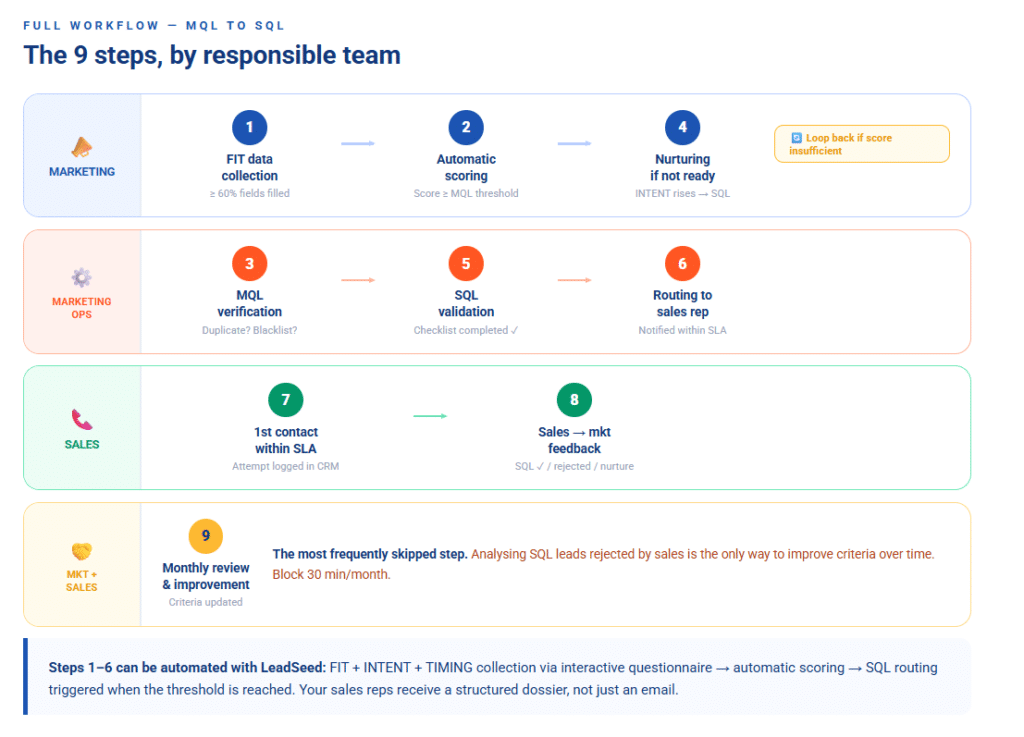
Finally, strong qualification requires alignment between Marketing and Sales.
Both teams must share the same definition of what constitutes an MQL, the same maturity criteria and a shared vocabulary to evaluate lead quality. 


The Concrete Impact: A Shorter Sales Cycle and Better Prioritization 

Improving qualification has an immediate effect on pipeline velocity.
Sales conversations become more relevant from the very first minutes, mature prospects emerge more quickly and Sales teams can prioritize high-value opportunities with greater accuracy. 

Organizations that invest in structured qualification consistently observe: 

A qualified lead enters the pipeline with fewer unknowns, shortening the journey from first contact to signed deal. 


Example: Enriched MQL vs. Classic Lead 

A classic lead generally provides limited value: a name, an email and a loosely defined interest.
Sales teams must reconstruct the entire context themselves, which extends every step of the cycle. 

An enriched MQL or MQL++, supported by declared data, behaves very differently: 

This level of context accelerates qualification, increases Sales acceptance rates and moves prospects faster through the funnel. 


Conclusion 

Improving sales qualification is one of the most effective ways to reduce the sales cycle.
By relying on declared data, structured frameworks, aligned teams and interactive content, organizations can significantly reduce friction in their pipeline. 

Better qualification means:
better prioritization, higher conversion rates and faster decision-making. 

This is exactly the approach leveraged by solutions such as MQL++, which deliver contextualized, enriched and sales-ready leads to accelerate the entire cycle.

🎯 Discover the Guaranteed MQL++ service and experience a new generation of performance-driven, transparent B2B lead generation. 

Learn more about Guaranteed MQL++


How to Generate Leads When Your Database Isn’t Reliable (Thanks to Guaranteed MQL++)


The reality: outdated and hard-to-use databases 

In many B2B companies, the CRM database is not reliable.
Incomplete records, outdated contacts, duplicates, invalid email addresses… data quality declines quickly.
On top of that, GDPR restrictions heavily limit the use of old files or purchased lists without explicit consent. 

As a result: 

*ICP: Ideal Customer Profile 


Why a high-quality database is essential 

A strong database is not just a list of email addresses.
It is a strategic asset that must include: 

A high-quality database enables you to deliver the right message to the right person at the right time, which is essential for providing sales teams with actionable leads. 

But what can you do when you no longer have a solid database? 

*ICP: Ideal Customer Profile 


Internal solutions to improve your database 

Before buying data or outsourcing lead generation, several internal actions can improve your data quality: 

These practices help maintain a healthy database, but they are not always enough to feed sales teams quickly. 


Hybrid solutions: buying a database + creating and distributing content 

Some companies choose to purchase external databases to accelerate prospecting.
In theory, this helps restart marketing activities quickly.
In reality: 

This is why many organizations turn to specialized lead generation services. 


Relying on an external service to generate guaranteed MQLs 

Instead of buying an unreliable list, a more effective alternative is to rely on a complete external provider.
Such a partner brings together three essential elements for generating high-quality leads: 

By combining these three pillars, organizations can generate guaranteed MQLs quickly, with consistent quality and zero risk. 

This is exactly what LeadSeed offers with its Guaranteed MQL++ service. 


The Guaranteed MQL++ service 

LeadSeed commits to both the volume and the quality of the leads delivered.
Each Guaranteed MQL++ includes: 


What sets MQL++ apart from a classic lead 


Classic Lead MQL++ LeadSeed
Collection method Simple form Interactive diagnostic
Data obtained Very limited Full context and needs
Transmission Cold Enriched handoff to Sales
Quality Variable Controlled and guaranteed
Sales acceptance rate Low 90% accepted

With MQL++, you don’t just receive a contact.
You receive a contextualized opportunity, ready for activation. 


Conclusion: generate qualified leads even without a database 

The days when you needed a massive CRM database to run campaigns are over.
With Guaranteed MQL++, you can now generate qualified leads even without an internal database, relying only on self-declared data and genuine prospect engagement. 

🎯 Discover the Guaranteed MQL++ service and experience a new generation of performance-driven, transparent B2B lead generation. 

Learn more about Guaranteed MQL++

How to Generate Highly Qualified Leads Through Interactive Content (The “Give to Get” Method)


Definition: MQL vs. MQL++ 

In B2B marketing, an MQL (Marketing Qualified Lead) is a contact who has shown some level of interest in your content or offer — downloading a white paper, attending a webinar, clicking on a campaign, etc.
But the truth is, many of these leads are cold: they’ve consumed content without real buying intent. As a result, Sales teams spend valuable time sorting, calling back, and qualifying… often with limited return. 

An MQL++, on the other hand, goes further.
It’s an enriched, qualified, and actionable lead: it includes insights into the prospect’s context, priorities, projects, and maturity level.
In short, an MQL++ is not just a name in a database — it’s a potential opportunity ready to engage. 


Comparing Traditional Content vs. MQL++ (Give to Get) 

The “Give-to-Get” Principle: Give Before You Get 

The Give-to-Get approach is simple: provide value before asking for anything in return.
Instead of forcing a download or a basic form, offer an interactive experience where the prospect immediately receives a personalized report, a guide, or a diagnostic. 

Objective: Capture Declarative Data (Zero-Party Data) 

Each interaction becomes a source of zero-party data — information voluntarily provided by the prospect, either online or through a phone conversation.
This data, far more precise and qualitative than behavioral or purchased data, helps you truly understand customer needs. 

The Psychology Behind the Model: A Win-Win Exchange 

The prospect gains clarity and tangible value (a useful diagnostic).
The company gains trustworthy, actionable insights.
It’s an ethical, personalized, and engaging approach that builds trust and increases conversion potential. 


Comparing Sales Performance 

The numbers speak for themselves: 

For Marketing, that means: less waste, better ROI, and stronger credibility with Sales.
For Sales, it means: more context, more valuable conversations, and better-quality meetings. 


The Problem: Content That No Longer Converts 

Most traditional content strategies still focus on volume: 

Example: a campaign with 500 downloads may result in only 3 truly usable leads. 

It’s the symptom of mass marketing: broad reach, but little business impact. 


The Benefits of the Give-to-Get Method for Lead Generation 

The Give-to-Get method flips the model upside down.
It’s a value-driven and personalized approach designed to build trust and deliver actionable data. 


Conclusion

Lead generation is no longer about filling up a CRM — it’s about creating useful, measurable conversations.
The Give-to-Get method turns your content into an engagement engine where every interaction delivers value to both sides. 

👉 Move from volume marketing to value-driven marketing.
Test the Give-to-Get method now with LeadSeed. 

Is Zero-Party Data The Future of Consent-Based B2B Lead Generation?


As a B2B marketer, you know that your prospects hold the keys to a goldmine of information: their needs, their budgets, their buying intentions. And under the right circumstances, they may be more than willing to let you in. 

But are you asking for access in the right way?  

Without zero-party data collection, you’re likely missing out on the most accurate, compliant, and conversion-ready insights.  

Because when you can capture the best insight data as early as possible, you gain a competitive advantage that few in your industry have. 


Ready to turn data collection into value exchange?

See how LeadSeed's Give-to-Get platform makes zero-party data collection easy and engaging. Try it now.


What Is Zero-Party Data? 

Zero-party data is information that prospects intentionally and proactively share with your brand.  

But unlike other data, zero-party data comes directly from the source itself – your potential customers who voluntarily provide their preferences, pains, budgets, and even buying intentions. 

Why the direct-give? Because there’s an evident value in the exchange, and prospects are willing to offer their best data for helpful content.  

How is Zero-Party Data Different? 

It’s important to recognize the difference between zero-party data and first or third-party data – your compliance and reputation depend on it. 

While prospects explicitly volunteer zero-party data through engagement with surveys, preference centers, or assessments, first-party data is passively collected through prospect behavior (think clicking emails or browsing your site). Third-party data is purchased from data brokers without direct prospect consent – which raises significant questions about collection methods. 

Privacy regulations are tightening, and with the disappearance of third-party cookies, zero-party data is quickly becoming the gold standard for compliant, accurate lead generation.  

The Triple Advantage of Zero-Party Data 

So, why make the shift toward a focus on prospecting zero-party data?  

B2B companies are reckoning with a data deprecation challenge as privacy laws ratchet up  – and are increasingly looking for ways to capture the best data while keeping leads satisfied. Zero-party data offers the best of both worlds. 

Zero-Party Data Offers the Accuracy Your Sales Teams Need 

Imagine a CMO “telling” you their marketing automation budget is $50,000-$100,000 via your on-page ROI calculator. That direct information is infinitely more reliable than trying to infer a budget from company size data you find online.  

Direct disclosure quickly eliminates sales-team guesswork and means your teams are working from accurate information from the start (which instantly boosts your credibility). 

Zero-Party Data Comes with Consent Baked-In 

Each piece of zero-party data comes into your system with explicit permission already included. The prospects know that they're trading information for value – and they are expecting a return on their data investment.  

By offering personalized content such as custom recommendations and reports, you build trust while keeping your B2B operations fully compliant with GDPR, CCPA, and other privacy laws. 

Zero-Party Data Allows for More Personalization Power 

Zero-party data allows B2B companies to offer hyper-targeted experiences that feel consultative rather than intrusive.  

Prospects and leads don’t want to feel “investigated” when they are engaged. But when marketing or sales teams can point to an already-provided pain point, the overall experience feels natural and tailored to specific outcomes. 


How Do B2Bs Collect Zero-Party Data? 

The key to successful zero-party data collection is making the value exchange crystal clear. That means creating give-to-get style content that feels natural and is easy to engage with – no matter the lead’s readiness. 

Interactive Content: The future is interactive – and maturity assessments or benchmarking tools are a great way to engage leads. Prospects simply input their performance metrics and receive personalized improvement roadmaps (while you get data that points to their challenges and readiness to buy). 

Strategic Surveys: Are you running lead-gen webinars? Offer post-webinar surveys that ask for any remaining questions or comments. You’d be amazed at how these simple questionnaires can give you excellent buying signals and help you improve your other interactive and personalized content. 

Value Calculators: One of the best ways to capture zero-party data is through value-related calculators. ROI calculators and TCO comparisons are great ways to capture easy data, and prospects feel they are receiving useful resources and ideas without much investment on their end. 

Integrating Zero-Party Data into Your Lead Intelligence Strategy 

Here’s where zero-party data really shines. When you start to integrate the collected zero-party data into your overall lead strategy, you’ll start to see just how quickly it works in your favor. 

Use Zero-Party Data to Enhance Lead Segmentation 

The more data you collect, the easier it becomes to build micro-segments based on self-declared interests and challenges.  

If a lead indicates they're "exploring options," you can target them further with educational content. Someone "ready to purchase within 3 months" might instead receive a comparison guide or implementation resources. 

Zero-Party Data Offers an Immediate Intelligent Lead Scoring Upgrade 

You can start to weigh zero-party data heavily in your scoring models. 

For instance, if a potential customer completes a personalized assessment and indicates an urgent timeline, you can use that data to score them much higher. The more fine-tuned the data, the cleaner your lead scoring. 

Predictive Nurturing Is Led By Zero-Party Data 

Smart B2B companies are leaning on predictive nurturing to predict the next-best actions throughout their funnels. With zero-party data, you can implement even smarter nurturing with hyper-specific insights.  

How LeadSeed Powers Zero-Party Data Across Your Sales Funnel 

LeadSeed has mastered the process of zero-party data collection through an innovative Give-to-Get platform 

Using custom-built intelligent surveys and interactive assessments, you can give your prospects even more reason to engage with your company and offer key data. In return, they receive resources and guidance that’s designed for them – personalized reports, benchmarks, and recommendations. 

LeadSeed’s no-code builder means you can rapidly deploy sophisticated data collection experiences across your channels. Now you can automate and optimize your lead scoring based on zero-party responses (and your sales team will thank you for it!) 

Experience the Future of B2B Data Collection with LeadSeed Now 

Privacy regulations are growing, and buyers are increasingly wary of data collection. That means the right data is more valuable than ever.  

Zero-party data collection will continue to be one of the most effective ways to ensure you’re targeting the right leads in the best ways.  

The future belongs to brands that ask rather than assume. Learn more about how you can start deploying smart content and capturing zero-party data today with LeadSeed. 

Book a Demo Now